



Preventing sleep wrinkles: What really helps
Sleep wrinkles are caused by mechanical pressure during sleep, not by facial expressions. Anyone who notices imprints or fine lines on their face in the morning has probably heard of this phenomenon. In this article, we explain how sleep wrinkles develop, what research says about them, and what measures can help prevent them.
What are sleep wrinkles and how do they form?
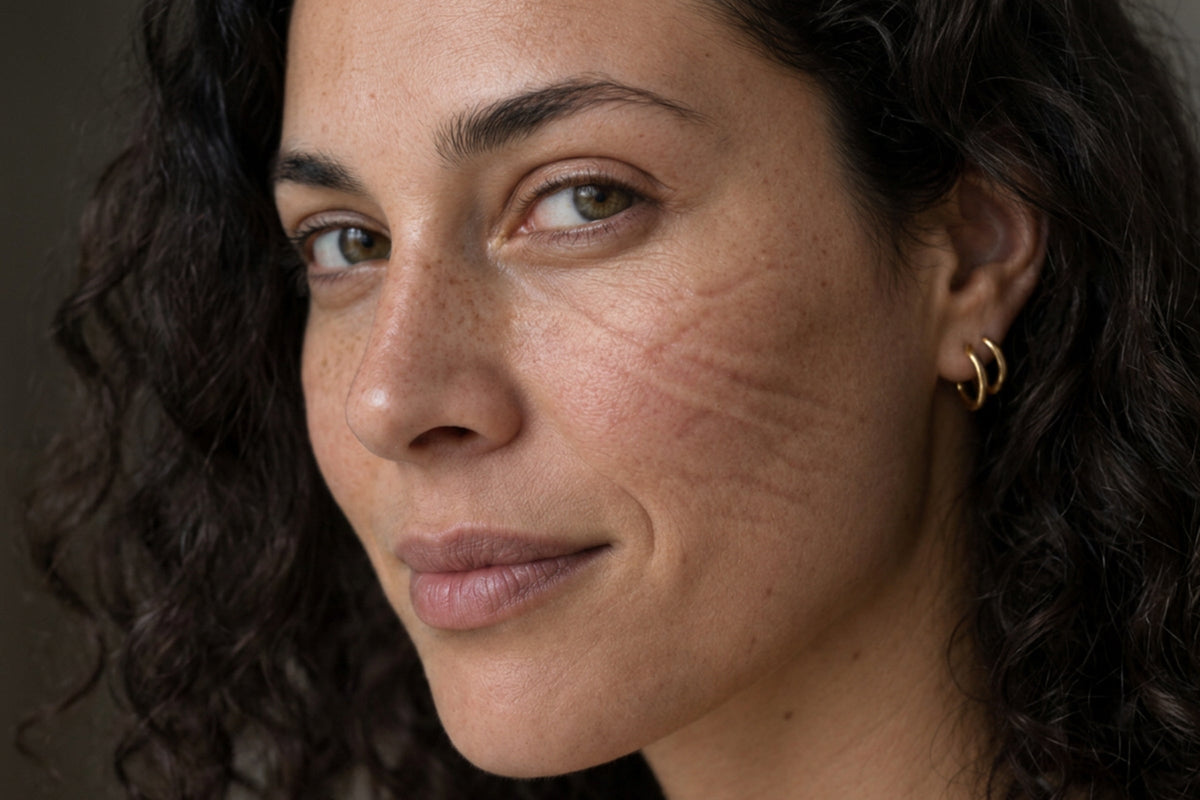
Sleep wrinkles are caused by repeated pressure when the face is pressed against a pillow for hours. Three mechanical forces act on the skin during this process:
- compression: Pressure presses the skin against the sleeping surface.
- Shear forces: The skin is shifted laterally
- Tensile stress: The skin is pulled in a direction that runs perpendicular to the facial muscles.
Unlike expression lines, sleep wrinkles often run vertically. They typically appear on the forehead, eyebrows, around the eyes, cheeks, chin, and in the nasolabial folds.
A 2016 review article explicitly distinguishes between sleep wrinkles and expression lines. Expression lines are caused by repeated muscle movement. Sleep wrinkles are caused by repeated mechanical deformation of the skin while lying on one's side or stomach.
Another study has made this mechanism visible. Using a special measurement method, impressions on the face were documented that arise simply from resting on a pillow: fine lines at the outer corners of the eyes, lines around the mouth, and a flattening of the forehead.
Sleep and skin aging: more than just pressure
Sleep quality influences skin aging independently of mechanical pressure. A study on the relationship between sleep quality and skin aging found the following in individuals with poorer sleep quality:
- Signs of faster visible skin aging
- Reduced regenerative capacity of the skin barrier after stress
Sleep wrinkles are therefore only one part of a larger connection between sleep and skin health. Sufficient and good-quality sleep has a positive effect on the skin's appearance, regardless of the pillowcase used.
What role does sleeping position play?
Sleeping on your side or stomach increases pressure on the face more than sleeping on your back. Those who sleep on their side or stomach press their face more directly and for a longer period against the pillow. A study with female participants who predominantly slept on one side of their body showed a more pronounced change in wrinkle density on that specific side of the face.
The authors of the 2016 review article generally consider sleeping on your back to be more beneficial. However, they also point out that consciously changing your sleeping position is difficult to implement in practice. This makes other factors – such as the material of the pillowcase – all the more important.
What can help against sleep wrinkles?
The right pillowcase
A smooth, low-friction pillowcase can reduce mechanical stress on the skin during the night. A scientific study found a measurable reduction in facial wrinkle density after 28 nights spent on a specially designed pillow.
This is precisely where the products in our Beauty Sleep Collection come in. Our pillowcase made of lyocell offers a particularly smooth surface that can reduce friction between skin and pillow. Our sleep cap, made of the same material, also protects hair from unnecessary mechanical stress during the night. Neither product replaces skincare – they complement your nightly routine by creating the most skin- and hair-friendly sleep environment possible.
Moisture before bedtime
An intact skin barrier retains moisture and makes the skin more supple. This can help to better cushion mechanical pressure overnight. We explain which ingredients support the skin barrier in our article. What really strengthens the skin barrier?
Active ingredient care overnight
The skin is particularly receptive to skincare ingredients during sleep. Many of our Face Patches They are suitable for overnight use and can be easily integrated into an evening routine.
A relaxing evening routine
One Gua Sha massage Before bed, facial muscles can relax and prepare the skin for the night. This effect works independently of the mechanical pressure during sleep – it complements a routine that is less stressful for the skin overall.
Regularly changing pillowcases reduces additional friction caused by residues from care products and sebum.
Frequently Asked Questions about Sleep Wrinkles (FAQs)
When do sleep wrinkles start to appear?
Sleep wrinkles can develop at any age, as they are caused by mechanical pressure and not by skin aging. However, with increasing age and decreasing skin elasticity, they often become more visible and fade more quickly.
Do sleep wrinkles disappear on their own during the day?
On younger, more elastic skin, morning pressure marks often disappear during the day. Over time, however, repeated pressure can lead to the development of more permanent wrinkles.
Is simply changing your pillowcase enough to prevent sleep wrinkles?
A low-friction pillowcase is one component, but it doesn't replace a holistic routine. Sleeping position, skincare, sleep quality, and sun protection also contribute to how the skin develops in the long term.
Do I need to change my sleeping position to prevent sleep wrinkles?
Switching to a supine sleeping position is considered beneficial, but is often difficult to implement in everyday life. A low-friction pillowcase can help reduce mechanical stress on the skin, regardless of sleeping position.
Conclusion
Sleep wrinkles are caused by repeated mechanical pressure during sleep. They are therefore a distinct phenomenon, different from classic expression lines or age wrinkles. Sleeping position, sleep quality, pillowcase material, and a well-structured nightly routine can all help reduce pressure on the skin. Supplementing your skincare routine with a sleep environment that is as skin- and hair-friendly as possible also benefits your skin beyond just creams and serums.
Sources
Anson, G., Kane, MAC., & Lambros, V. (2016). Sleep Wrinkles: Facial Aging and Facial Distortion During Sleep. Aesthetic Surgery Journal, 36(8), 931-940. https://doi.org/10.1093/asj/sjw074
Poljsak, B., Godic, A., Lamp, T., & Dahmane, R. (2012). The influence of sleeping on the formation of facial wrinkles. Journal of Cosmetic and Laser Therapy, 14(3), 133-138. https://pubmed.ncbi.nlm.nih.gov/22506801/
Oyetakin-White, P., Suggs, A., Koo, B., Matsui, MS, Yarosh, D., Cooper, KD, & Baron, E.D. (2015). Does poor sleep quality affect skin aging? Clinical and Experimental Dermatology, 40(1), 17–22. https://doi.org/10.1111/ced.12455

author
Katja
Lead Product Developer
With over 15 years of experience in the cosmetics industry, Katja develops skincare products that combine effectiveness with gentle care. Her focus is on skincare routines that can be easily integrated into everyday life and provide long-term skincare benefits. At APRICOT, she oversees product development from the initial concept to the finished product.



Leave a comment
This site is protected by hCaptcha and the hCaptcha Privacy Policy and Terms of Service apply.